VSD Pump vs Fixed-Speed Pump: Which One Your House Needs

Two pumps can look identical on the plinth and behave completely differently in the shower. One runs flat out, stops, and starts again. The other picks a pressure and holds it. Here is what the difference feels like, what it costs, and when each is the right answer.

Same Pump, Different Control
The Shower Tells You
Randburg Based
The upstairs shower goes cold every time somebody opens the kitchen tap. The pump is only a year old.

Here is the call, in a version we take most months. A Parkhurst double-storey, a year-old booster pump on a properly plumbed system, and an upstairs shower that goes cold every time somebody opens the kitchen tap. The owner assumed the pump was too small. It was not. It was a fixed-speed pump doing exactly what a fixed-speed pump does.

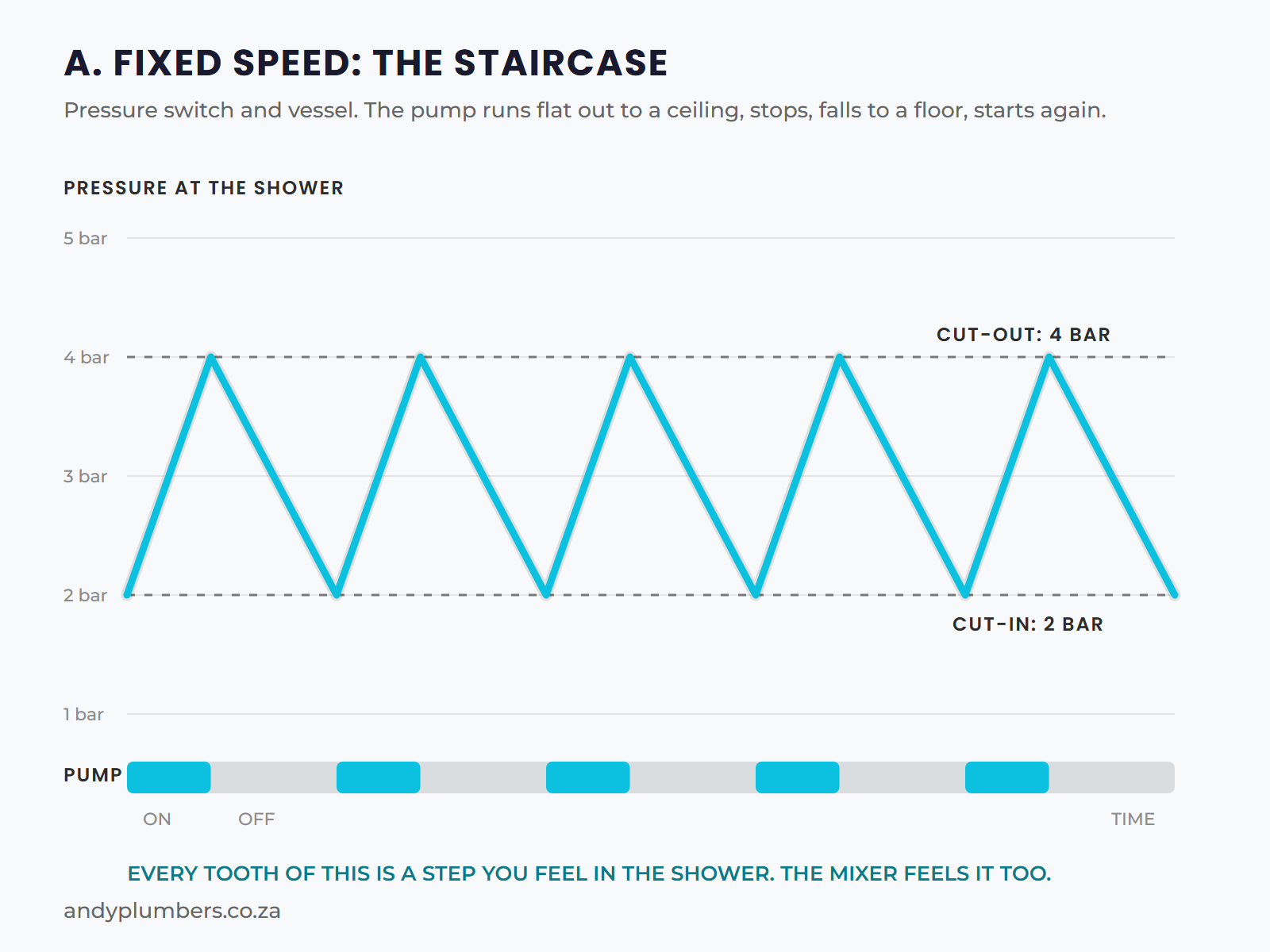
We watched the gauge. The pump ran flat out until the pressure reached 4 bar, stopped, let the pressure fall to 2 bar, and started again. A thermostatic mixer can hold a temperature at 4 bar, or at 2 bar. It cannot hold one while the pressure walks down a staircase between them. Every tooth of that staircase was a cold moment in the shower, and the kitchen tap simply made the teeth come faster.

Nothing was wrong with the pump. The control was wrong for the house. This page is the difference between the two kinds of control: what each one feels like, what each one costs, and which houses need which.
They Are the Same Pump. The Control Is the Difference

Nearly every domestic booster pump is a centrifugal pump. What changes is how it is told to run: a switch, a flow controller, or a drive that changes its speed.

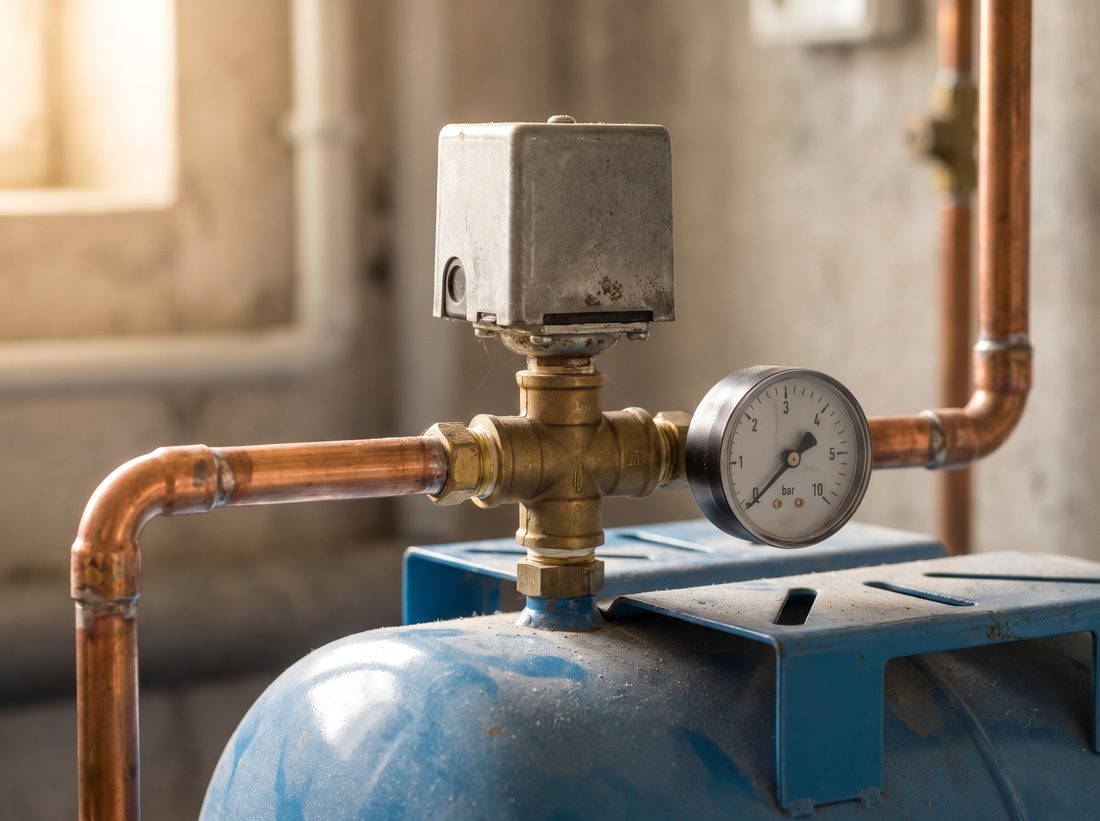
Pressure Switch and Vessel

The classic fixed-speed setup. The pump runs flat out until the pressure reaches the cut-out, often 3.5 to 4 bar, and stops. A pressure vessel feeds the house as the pressure falls to the cut-in, often 2 bar, and the pump starts again. The house pressure is a staircase, and the size of the vessel decides how often the pump cycles.

  • Two states: on and off
  • Pressure swings between cut-in and cut-out
  • Vessel size sets the cycling rate
  • Cheap to buy, cheap to fix
  • Contacts corrode and hunt as they age

Flow Controller

The small electronic box on top of many pumps. It starts the pump when it senses flow and stops it when flow stops, with little or no vessel. Pressure is whatever the pump happens to make at that flow. A dripping tap or a small leak cycles it all day. Simple and robust, and the one we find on most standby backup systems.

  • Starts on flow, stops on no flow
  • Pressure follows the pump curve
  • A drip cycles it endlessly
  • No vessel to take the hits
  • Common on budget installs

Variable-Speed Drive

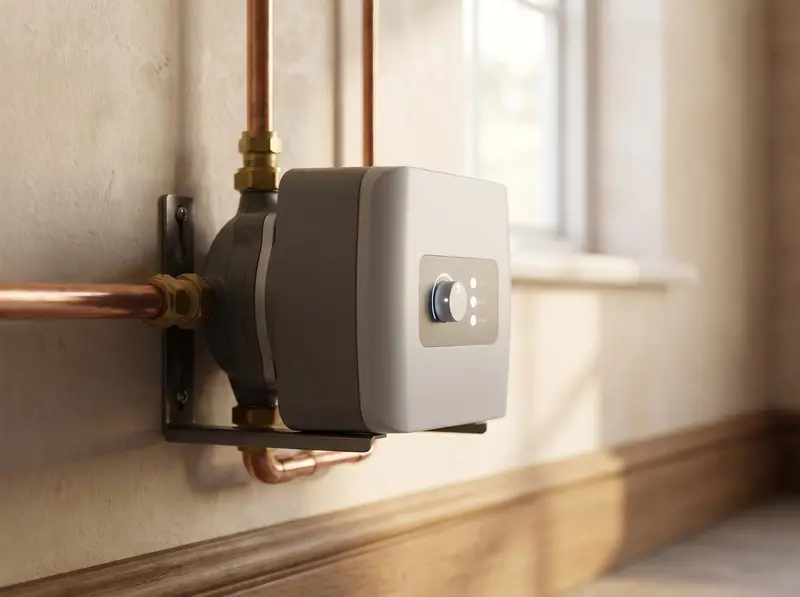
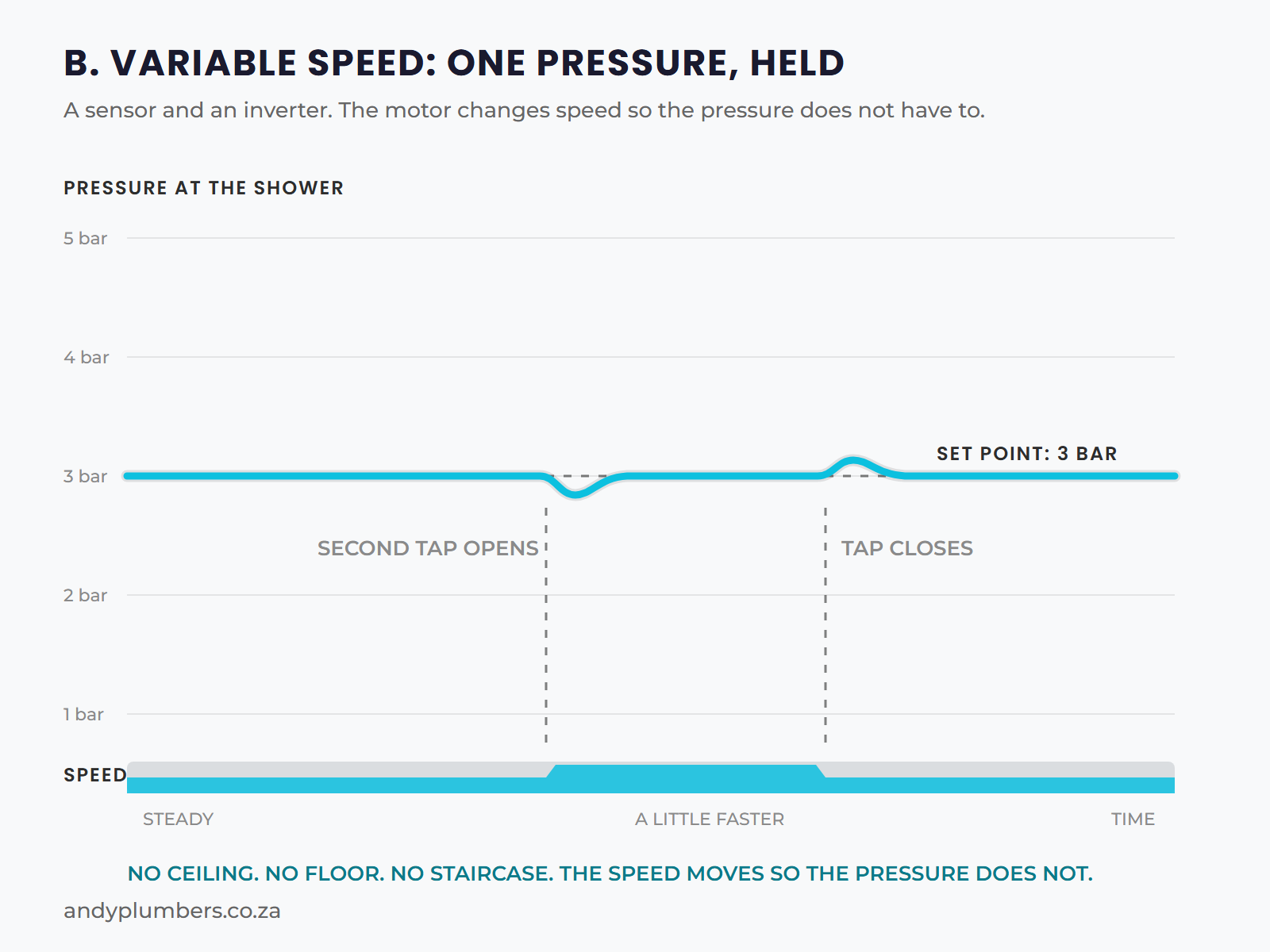
A pressure sensor and an inverter. You set one pressure, typically around 3 bar for a house, and the drive changes the motor speed to hold it. Open a second tap and the motor speeds up a little. Close it and the motor slows. Soft start, far fewer start-stop cycles, quieter, and it draws only the power the moment needs.

  • One set pressure, held
  • Soft start, no hammer
  • Dry-run protection built in
  • Draws only what the moment needs
  • Electronics: wants clean power

What the Shower Feels

The same house and the same pump, plotted over a minute. One line is a staircase. The other is a line.

Graph of water pressure at the shower on a fixed-speed pump: a sawtooth between a 2 bar cut-in and a 4 bar cut-out, with the pump switching on and off underneath

Fixed Speed: The Staircase

The pump runs to the ceiling, stops, falls to the floor, starts again. Every tooth is a step you feel.

Graph of water pressure at the shower on a variable-speed pump: a flat line held at 3 bar with a small dip and recovery when a second tap opens, and the motor speed rising underneath

Variable Speed: One Pressure, Held

The motor speed moves so the pressure does not. A second tap is a ripple, not a step.

Mechanical pressure switch and gauge beside a blue pressure vessel on a domestic booster pump installation

Switch, Gauge, Vessel

Randburg - The fixed-speed parts. Honest, simple, and the reason the shower has opinions.

How We Choose for a Specific House

Four questions, in this order. The answers decide the control before they decide the pump.

1

What Does the House Run On?

If the house lives on its pump every day, as it does on an inline backup system, the pump is the water pressure. Every shower, every day, feels the control. That alone pushes most of those houses to a variable-speed drive. If the pump only lifts a garden tap or an irrigation line, nobody is standing in it.

2

How Many Things Run at Once?

One bathroom and a kitchen can live with a staircase. Two bathrooms, a rain shower, a thermostatic mixer, or a double-storey with the shower upstairs cannot. A mixer holds a temperature at one pressure, not across a swing, and a rain shower shows every change in flow.

3

What Is the Power Like?

A variable-speed drive is electronics. It wants a surge protector and, if the house has an inverter, a clean sine-wave output. The spike when load shedding ends has killed boards. Fixed-speed pumps shrug that off. If the supply is rough and nobody will fix it, that counts.

4

What Happens When It Breaks?

A pressure switch is a small part and a short visit. A drive fault is usually a board. We price both honestly. For a house that depends on its pump, we also talk about what happens in the days a part takes to arrive, which is where the bypass on a properly plumbed backup system earns its place.

The Honest Comparison

Neither is the right answer everywhere. This is where each one wins, and where it loses.

Where Variable Speed Wins

In the shower, first. One pressure, held, whether one tap or four are open. Then in the plant room: soft starts instead of hammer, a fraction of the start-stop cycles, a quieter motor, and a lower power draw because the motor only runs as hard as the moment needs. Built-in dry-run protection means an empty tank does not cost you a pump.

  • Constant pressure at every tap
  • No hammer, far fewer cycles
  • Quieter and lighter on power
  • Dry-run protection built in

Where Variable Speed Loses

Price, two to three times a fixed-speed unit. Electronics that dislike dirty power, surges and the voltage spike when load shedding returns, so it wants a surge protector and a clean inverter output. And repair: a fault is a board, not a switch. None of these are reasons to avoid it. They are reasons to fit it properly and to know what you are buying.

  • Two to three times the price
  • Needs surge protection and clean power
  • A fault is a board, not a switch
  • Overkill for a single outside tap

Where Fixed Speed Is the Right Answer

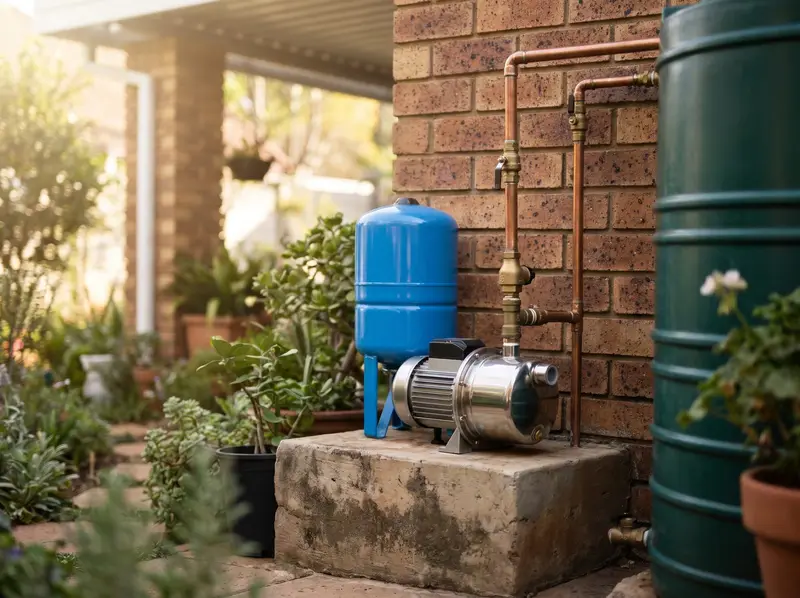
A garden tap. An irrigation line. A single outside bathroom. A pump that runs for ten minutes a day and nobody stands under. Here the staircase does not matter, the simplicity does, and the switch will outlive the drive's electronics. We say so, and we fit it.

  • Garden and irrigation
  • Low daily use
  • Rough power supply
  • Simplest repair

The 400 kPa Detail

South African geysers sit behind a pressure control valve, usually 400 kPa. Whatever the pump does above that is thrown away on the hot side. So the question is never how high the pump can push. It is how steady the pressure is at the valve, and how much flow reaches the mixer. That is the whole case for a drive on a house with a good shower.

  • The geyser valve caps the hot side at 400 kPa
  • Steady beats high
  • Flow is what you feel
  • Pressure vs flow gets its own guide

Pumps on Backup Systems Across Randburg

Most of the pumps we fit now sit on inline backup systems, where the pump is the house's water pressure every day. How that system should be plumbed is drawn out in our backup water system installation guide. On those houses the control decides what every shower feels like, so a variable-speed drive is usually the right call, set a touch above the street pressure so the tank stays in use and the bypass non-return stays shut.

The suburbs tell the story. On the Northcliff ridge the double-storeys have the shower upstairs and the pump at the bottom of the garden, which is the worst place to feel a staircase. Parkhurst townhouses with one bathroom and a short run often do fine on a switch with a properly sized vessel, and we say so. In Fairland, where the power is rough on some streets, a drive goes in with surge protection as standard and the inverter gets checked for a clean sine wave before the pump is connected to it.

What we fit and how we size it is on the booster pump installation page. Borehole pumps are a separate case, with the drive at the surface controlling a submersible, covered under borehole pump installation.

One quiet observation. You can tell which control a house has from the shower, with your eyes shut. If the temperature has opinions, it is a switch.

Common Questions About VSD and Fixed-Speed Pumps

Is a VSD pump worth it for a small house?

If the house runs on the pump every day, usually yes, even with one bathroom, because the drive is what makes the shower feel like a normal shower. If the pump only serves the garden, no. The honest test is whether anyone stands in the water the pump is moving.

Will a variable-speed pump survive load shedding?

The drive itself does not mind being switched off. What hurts it is the spike when the power returns, and a rough inverter waveform. Fit a surge protector, and if the pump runs from an inverter, make sure it is a pure sine-wave unit. With those two in place the drives we fit have been reliable.

How much more does a VSD pump cost?

Typically two to three times the price of a fixed-speed pump of the same duty, before installation. The plumbing is the same either way, so the difference is in the unit. Against that, it draws less power and cycles far less, which is the difference in how long the motor lasts.

Can my existing fixed-speed pump be converted to variable speed?

Sometimes. An external drive can be fitted ahead of a standard single-phase pump, and that is a fair halfway for a pump that is still in good order. More often, by the time the shower is the complaint, the pump is also due, and an all-in-one variable-speed unit is cleaner and cheaper than a drive plus an old pump.

Why does my shower go hot and cold when the pump runs?

Because the pressure is walking between the pump's cut-in and cut-out, and the mixer cannot hold a temperature across a swing. It is worst with a thermostatic mixer and a second tap open somewhere. A larger vessel softens it. A variable-speed drive removes it.

How long does each type of pump last?

A fixed-speed pump with a switch is simple and can run for many years, with the switch and the vessel as the service items. A variable-speed pump's motor sees far fewer starts and runs cooler, so the mechanical side lasts well. The board is the part that needs clean power to match it.

Does a VSD pump use less electricity?

Yes. A fixed-speed pump runs at full power every time it starts, whether one tap or four are open. A drive runs the motor only as hard as the moment needs, so most of the day it is loafing. The saving is real, though on a domestic pump the better reason is the shower.

Same Pump. Different Control.

A switch gives you a staircase. A drive gives you a line. Which one your house needs depends on what runs on the pump and who stands in the water. Business hours across Randburg, Fairland and Northcliff.