How a Backup Water System Should Be Plumbed (and How Most Are)

A tank, a pump and a few valves can be connected to a house two ways. One way, the tank is full of fresh water and the pump ran this morning. The other way, the tank has been standing since the last outage. The parts cost the same. The difference is where you cut in.

Inline, Not Standby
Fresh Water Every Day
Randburg Based
The tank is full. It has never given a problem. Then the water went off, and what came out of the tap smelled like a pond.

Here is the call, in a version we have taken many times. A homeowner in Northcliff had a backup system fitted a couple of years ago. Tank on a plinth, pump beside it, and the installer said it would take over on its own. It did. On the first morning of a long outage the shower ran weak and warm, and the water had a smell the family could not place.

When we traced the pipework the picture was familiar. The fill had been teed off the nearest pipe, the garden-tap line that happened to pass the plinth, and the pump had been brought back into that same line. The pressure switch was set below street pressure, so the pump only started once the municipal supply gave up. Until that morning it had started perhaps a dozen times in two years. The water in the tank was as old as the last outage.

Nothing in that system was broken. Every component was doing what it had been piped to do. It had simply been connected in the one way that guarantees the tank is stale on the day it is needed. This page sets out the other way, component by component, so you can tell at a glance which one you have.
Two Ways to Connect a Tank to a House

Same tank, same pump, same valves. The difference is where the main line is cut and what the house runs on day to day.

Standby: Teed Off the Nearest Pipe

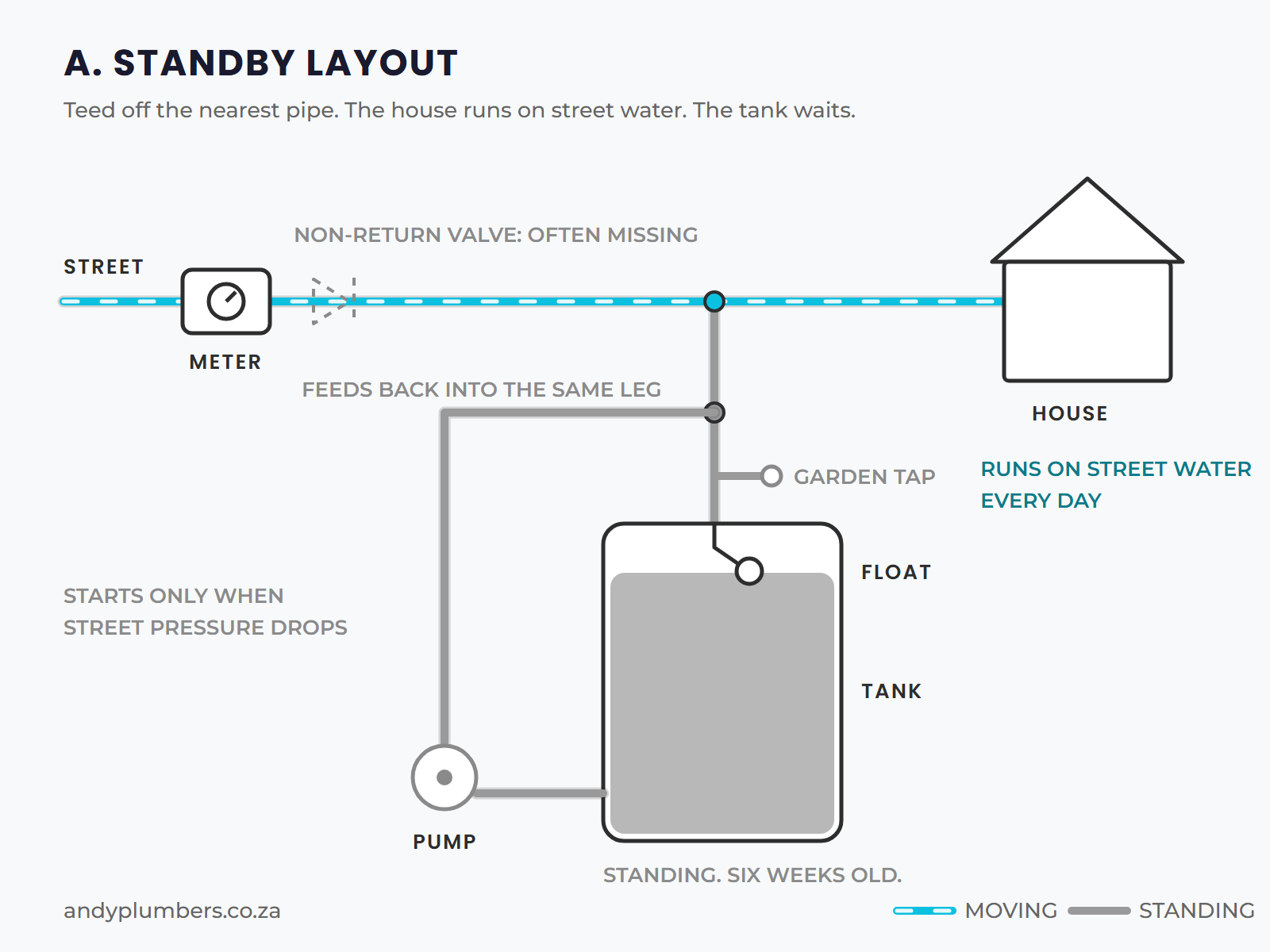
The tank fills from whichever pipe passes closest to it, often the garden-tap leg. The pump feeds back into that same leg, with its pressure switch set below street pressure so it only starts when the municipal supply drops. The house runs on street water every day. The tank waits.

  • Tank water stands between outages
  • Pump idle for six weeks at a time
  • Pump pushes against the street on the same leg
  • Fill and feed through a 15 mm branch
  • Pressure switch hunts near its cut-in

Inline: Through the Tank, Every Day

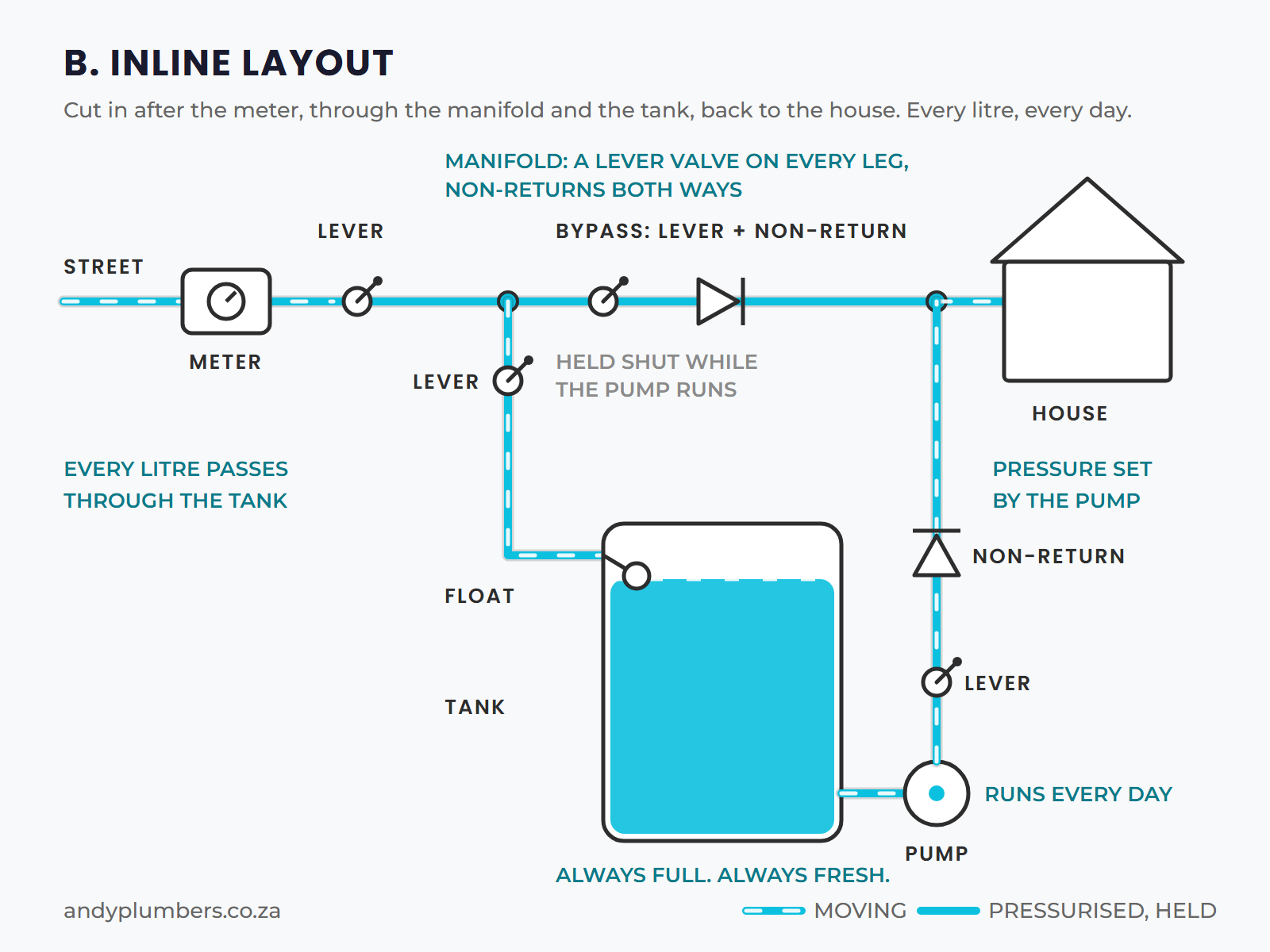
The main line is cut after the meter and goes into the tank first. The house runs on the tank and the pump all day, every day. The float tops the tank up as water is used, so the water in it is always fresh, and the pump proves itself every morning.

  • Every litre passes through the tank
  • Topped up with fresh water as it is used
  • Pump exercised daily
  • Pressure set by the pump, not the street
  • An outage changes nothing you can see

The Manifold

Where the street, the tank and the pump meet: a lever valve on each leg and a non-return valve both ways. While the pump runs its pressure is higher than the street's, so the bypass non-return stays shut and the house drinks from the tank. If the pump stops, that non-return opens on its own and the street feeds the house. Nothing to switch.

  • Lever valve on every leg
  • Non-return valves both ways
  • Pump cannot push into the street
  • Street takes over on its own if the pump stops
  • Close two levers to clean the tank

The Two Diagrams

Same components, two layouts. Grey water is standing. Turquoise water is moving. That is the whole difference.

Diagram of a standby backup water system: the municipal main runs straight to the house, the tank is filled from a garden tap branch and the pump feeds back into the same branch, so the tank water stands

Standby, Same-Leg Feed

The tank fills and feeds through one branch off the garden line. The house never touches the tank until the street fails.

Diagram of an inline backup water system: meter, lever valve, manifold with a tank-feed leg, a bypass leg and a pump-return leg, lever valves on each leg and non-return valves both ways, float valve into the tank, pump out of the tank back through the manifold to the house

Inline, Through the Tank

Meter, lever valve, manifold, float, tank, pump, back through the manifold. Non-returns both ways. Every litre takes the long way round, every day.

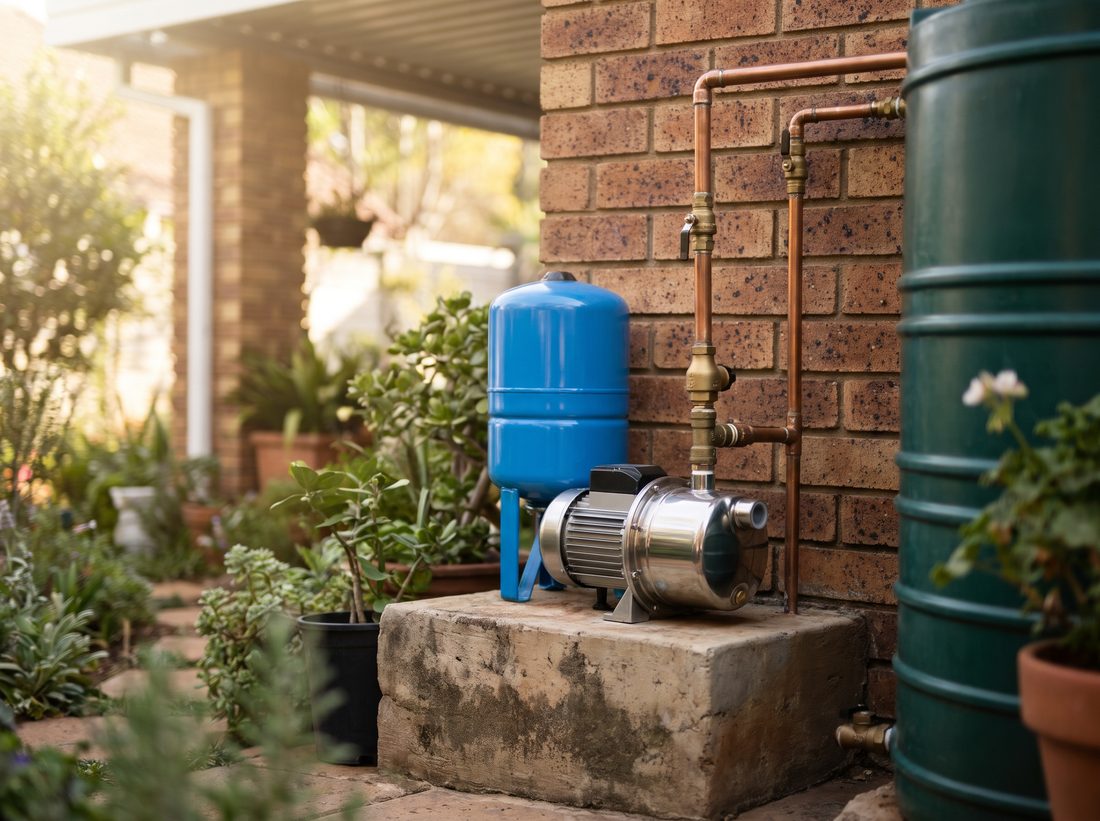
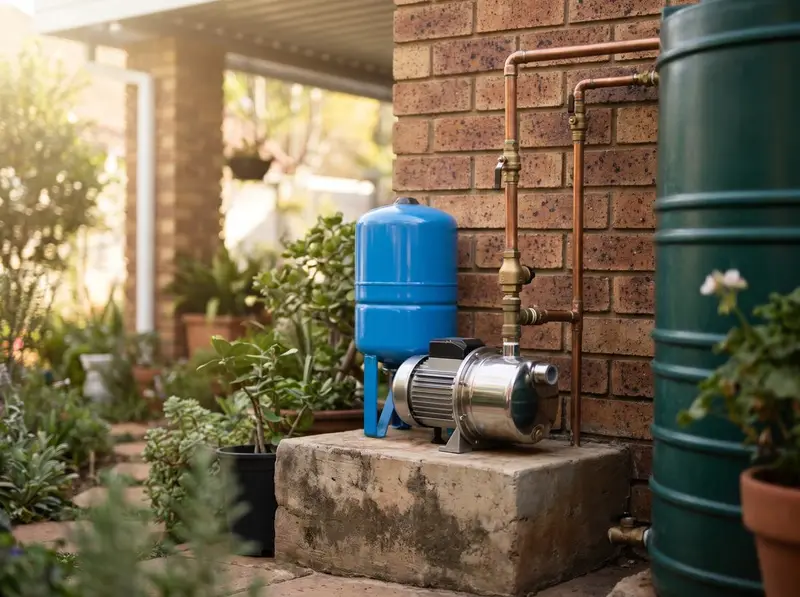
Booster pump, pressure vessel, isolation valves and non-return valve on a concrete plinth beside a backup water tank in Randburg

Pump, Vessel and Valves

Randburg - Isolation either side, non-return on the outlet, strainer on the suction. The parts that make the inline layout serviceable.

The Inline Layout, Component by Component

From the meter to the taps, in the order the water travels. Each part has one job, and the order is not negotiable.

1

Meter, Lever Valve, Manifold

Straight after the water meter: a lever valve so the whole system can be shut off, then the manifold, where the street splits three ways. One leg feeds the tank. One leg is the bypass to the house, through a non-return valve. One leg brings the pump back in, through its own non-return valve. Lever valves on each leg, non-returns both ways. A pump may not draw on or push against the municipal main, and this is what makes sure it never does.

2

Float Valve Into the Tank

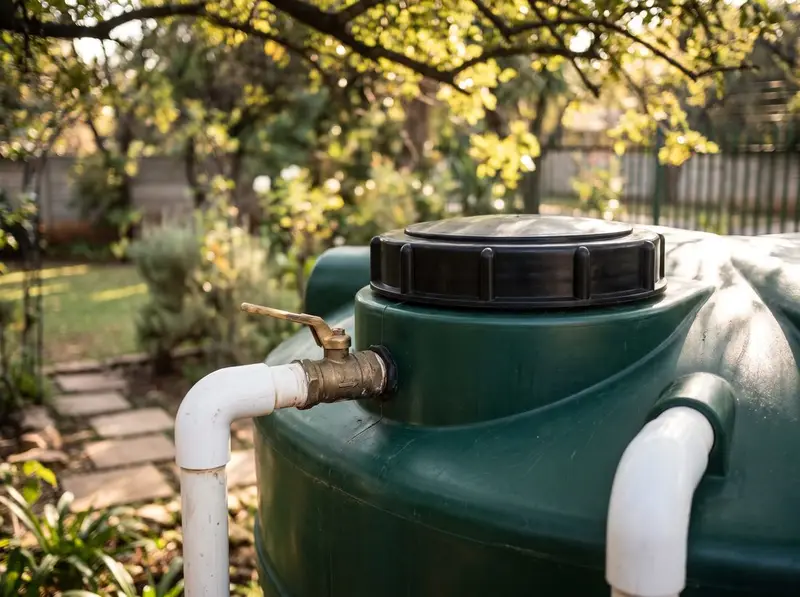
The main line goes to a float valve mounted near the top of the tank, with its outlet above the full water line. That gap is the air gap. The float opens as the level drops and closes as it recovers, so the tank is topped up continuously at whatever rate the street can manage. It only has to keep pace with the day's use, not with the shower.

3

Tank to Pump

A screened draw-off low on the tank, an isolation valve, a strainer, then the pump. Dry-run protection so the pump cannot destroy itself on an empty tank. Control by a variable-speed drive, or a pressure switch with a vessel. Isolation on the outlet too, so the pump can come out for service without draining anything.

4

Pump Back Through the Manifold

A lever valve and a non-return valve on the pump outlet, then full-bore pipe, 22 mm or larger, back into the manifold on the house side. We set the pump above the street pressure, so while it runs the bypass non-return stays shut and every litre the house uses has been through the tank. If the pump ever stops, the street takes over through the bypass without anyone touching a valve.

Why the Standby Layout Fails Quietly

Nothing in a standby system is faulty. It is the layout that lets it down, in a few predictable ways, usually in this order.

The Water Is as Old as the Last Outage

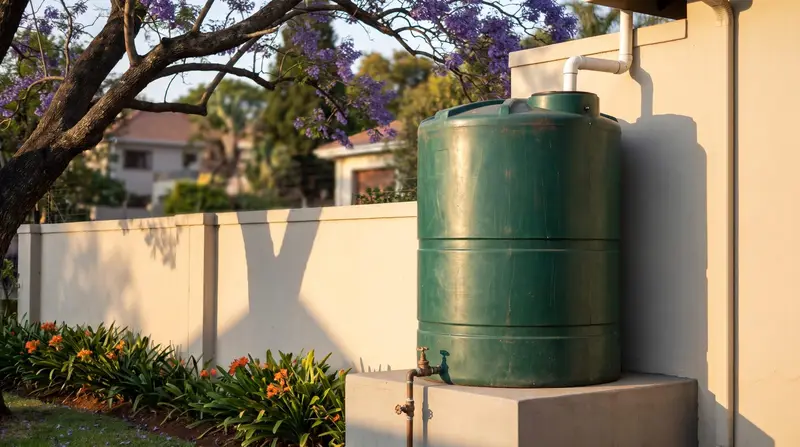
The house runs on municipal water day to day, so the tank is filled once by the float and then stands. Six weeks is a normal gap between outages, so six weeks is how long it stands, in a plastic vessel in a Randburg garden. A biofilm settles on the walls, the chlorine is gone within days, and if the lid is loose or the tank is translucent, algae join in. The first water the family draws during an outage is the oldest water on the property.

  • Chlorine fades within days of standing
  • Biofilm on the walls between outages
  • Warm, still and dark: the recipe for a smell
  • The outage serves the stalest water first

The Pump Is Never Proven

A pump that starts a dozen times in two years is a pump nobody has checked. Seals dry out, the impeller sticks, the pressure switch contacts corrode in the garden air. The first long outage is the first time anyone finds out, and by then there is no water to test it with. A pump that runs every morning is tested every morning.

  • Seals and impellers prefer daily use
  • Pressure switch contacts corrode when idle
  • The fault is found on the worst possible day
  • Inline: proven at every tap, every day

The Pump Fights the Street

Feeding back into the same leg that fills the tank means the pump pressurises the very pipe the float valve hangs off. Without a non-return valve at the meter, tank water heads back toward the street. With one, the pump sits against municipal pressure and short-cycles while the pressure switch hunts around its cut-in point. Either way, the garden-tap branch it all runs through was never sized to carry a house.

  • Same leg for fill and feed
  • No non-return at the meter: backflow to the street
  • Non-return at the meter: hunting and hammer
  • A whole house through a 15 mm branch

What the Inline Layout Gives Back

Every litre the household uses passes through the tank, and the float replaces it with fresh municipal water as it goes. The tank is always full and the water in it is always fresh, because it never stands. The pump runs daily. The pressure is set by the pump, often steadier than the street. When the supply goes off, the only thing that changes is that the float stops moving and the tank starts drawing down, which for a 2,500 litre tank at normal use is about three days of water. Two tanks, a week.

  • Always full, always fresh
  • Pump proven daily
  • Pressure set by the pump
  • Outage: the float stops, nothing else

Outages, Load Shedding and Fixing What Is Already There

An inline system needs the pump to run for every litre, which makes load shedding the honest question. When the power goes the pump stops, the bypass non-return opens on its own, and the house runs on street pressure until the pump comes back. Nobody touches a valve. The only time that is not enough is an outage and load shedding at the same time, and for that an inverter carries the pump. A domestic booster pump draws roughly 0.75 to 1.1 kW while running and runs in short bursts, so a modest inverter and battery carry it comfortably, sized to the pump's starting current, not its running current, which is the detail that catches people out.

If you already have a standby system, the fix is usually a half-day of re-piping rather than new parts. The tank, pump and vessel stay. The fill moves from the garden branch to the manifold after the meter. The pump outlet moves from the garden branch to the manifold's house side, through its non-return valve. The bypass leg and its non-return go in. The pressure switch or drive is reset so the pump, not the street, decides the house pressure. In Fairland and Northcliff, where the tank usually stands on a plinth beside the house, the pipe runs are short. On a Parkhurst stand with the tank at the back, the run to the meter is the job.

The water in a standby tank is worth dealing with before the re-pipe. A tank clean and sanitise takes the biofilm off the walls so the inline system starts fresh. If you are at the beginning and do not yet have a tank, the JoJo tank installation page covers siting and sizing, the tank installation cost guide covers what a working system costs, and the municipal water backup page covers the full system. For the pump itself, including why a variable-speed drive suits a house that lives on its pump, see booster pump installation.

One quiet observation to end on. Two systems can look identical from the garden: same tank, same pump, same blue vessel. Open the first tap on the morning of an outage and you will know within a second which one you have.

Common Questions About Backup System Layout

Can my existing tank and pump be re-piped to run inline?

Almost always. The tank, pump and pressure vessel stay where they are. The fill moves to a manifold after the meter, the pump outlet comes back into that manifold through a non-return valve, the bypass leg with its own non-return goes in and the pump control is reset so the pump sets the house pressure. On a tank beside the house it is about half a day. A longer run to the meter adds pipe and time, not parts.

Does the water in a backup tank really go off?

It changes. Municipal water arrives with a small amount of chlorine that fades within days of standing. After that a biofilm forms on the tank walls, the water warms in the sun and the taste goes flat or musty. In a translucent tank, or one with a loose lid, algae follow. None of this happens when the water is replaced as it is used, which is what the inline layout does.

How fresh is the water in an inline tank?

Always fresh. Every litre the house draws is replaced through the float as it goes, so the tank stays full of fresh municipal water all day. It never stands, which is the whole point of cutting in after the meter rather than at the garden tap.

What happens during load shedding with an inline system?

The pump stops, the bypass non-return opens on its own and the house runs on street pressure until the power returns. No valves to touch. If the street is off at the same time, an inverter sized to the pump's starting current keeps the tank water flowing, and most homes that fit an inline system already have one.

Is a non-return valve at the meter not enough on its own?

It stops backflow into the street, which matters. It does nothing about the water standing in the tank or the pump sitting idle, because those come from where the fill and feed are connected, not from the valve. On a standby system it also turns backflow into hunting: the pump pushes against the closed valve and short-cycles. The manifold's non-returns give the same protection, both ways, in the right place.

Will running the house through the pump change my water pressure?

Yes, usually for the better. In the inline layout the pump sets the house pressure, so it is the same at six in the morning as at six at night, regardless of what the street is doing. We set it to suit the house, typically around 3 bar, and a variable-speed pump holds it there whether one tap or four are open.

Can I still clean the tank without the house going dry?

Yes. Close the lever valves on the tank-feed and pump legs of the manifold. The bypass non-return opens and the house runs on street pressure while the tank is drained, cleaned and refilled. That is what the levers are for.

Two Valves Apart

Same tank, same pump. Cut in after the meter and the house runs through the tank every day. Cut in at the garden tap and it waits. Business hours across Randburg, Fairland and Northcliff.